By Rene Anthere Rwanyange
East African countries are accelerating efforts to harmonise higher education systems, with the region targeting a common higher education area by 2030 to ensure qualifications are recognised across borders and improve the mobility of students and graduates.
The initiative seeks to address differences in national qualification frameworks, quality assurance, accreditation and regulatory systems that can make it difficult for graduates to have their qualifications recognised when they move between East African Community (EAC) partner states.
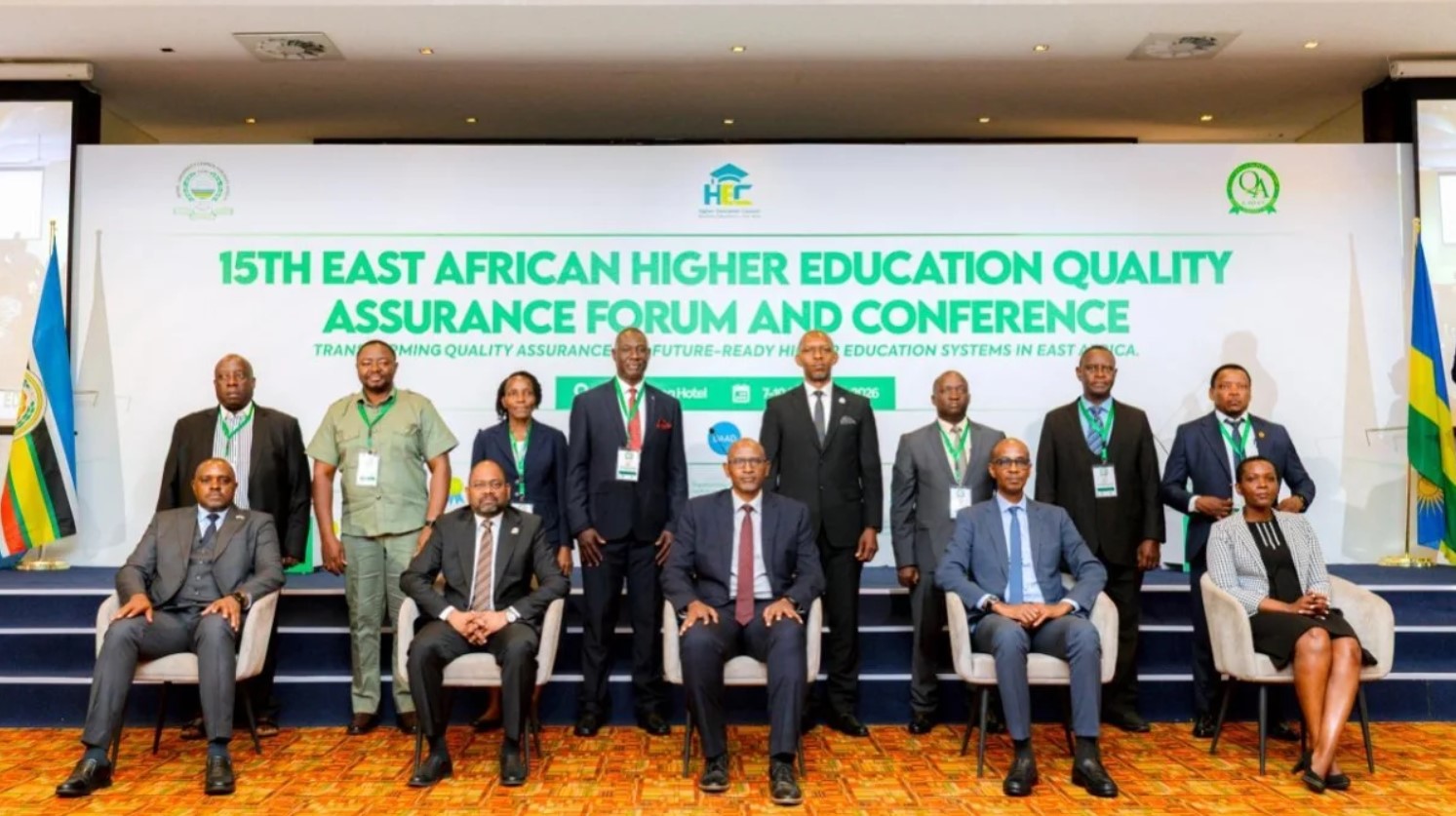
Speaking at the 15th East African Higher Education Quality Assurance Forum and Conference in Kigali, Rwanda’s Minister of Education, Joseph Nsengimana, says that removing these barriers is essential to making regional integration work for students, graduates and employers.
“We need a parent in Kampala to trust a degree earned in Kigali, an employer in Nairobi to have confidence in graduate training in Dar es Salaam, and a student to pursue learning across all universities without being held back by borders that should serve as a bridge rather than a barrier,” Nsengimana says.
Push for a common higher education area
Nsengimana says East Africa is making progress towards a common higher education system through the Inter-University Council for East Africa (IUCEA) and national higher education regulatory bodies.
The region already has a common higher education qualification framework, while EAC heads of state and education ministers have set 2030 as the target for operationalising the common higher education area.
“With the deadline now less than four years away, this must not create anxiety but must create urgency. We must accelerate harmonisation and address gaps in national regulatory frameworks,” Nsengimana says.
The proposed common area aims to allow students to study across EAC countries and graduates to use their qualifications across the region with fewer administrative barriers.
Harmonising different systems
Prof. Idris Rai, Acting Executive Secretary of IUCEA, says the council is working with EAC partner states to bring their higher education systems closer together.
“Our mandate is to look into higher education and to harmonise these diverse systems in order to allow for the integration of the East African Community,” Rai says.
He says the goal is to enable students to study in any EAC partner state and return home with qualifications that are recognised without unnecessary obstacles.
The common higher education area is expected to facilitate mutual recognition of qualifications, professional mobility and knowledge exchange.
However, Rai says harmonisation requires countries to adopt common policies, regulations and rules and, where necessary, amend national laws to accommodate regional frameworks, particularly on qualifications and quality assurance.
“It’s a long process. But our goal is to achieve that in 2030,” Rai says.
Common quality standards
Quality assurance remains central to the process. Rai says IUCEA works with national councils and commissions to develop regional recommendations that countries can adapt and implement.
The region has developed common frameworks covering quality assurance, programme accreditation and qualifications recognition. Several partner states are incorporating these frameworks into their national systems.
However, implementation remains uneven because countries are at different stages of developing their regulatory and quality assurance institutions.
The expansion of the EAC adds another challenge. Somalia, which joined the bloc in 2023, is still developing institutions and systems that need to be aligned with those of more established partner states.
“To harmonise all of them to be at the same level, it will take a bit of time. It’s difficult to predict, but our aspiration is by 2030,” Rai says.
Differences in qualification levels
Prof. Mary Okwako, Executive Director of Uganda’s National Council for Higher Education, identifies differences in national qualification frameworks as a major obstacle.
She says the same qualification can be placed at different levels depending on the country.
“For instance, in Rwanda, a doctorate is level seven, in Uganda it is level nine, while in Kenya and Tanzania it is level 10,” Okwako says.
She calls for national qualification frameworks to be aligned with the regional framework developed by IUCEA.
“Aligning doesn’t mean copying, but it means using the regional framework as a reference and including what is recommended into the national framework,” she says.
Okwako also points to differences in quality assurance and institutional accreditation, saying stronger and more consistent systems are needed to build trust in qualifications across the region.
Towards automatic recognition
A key long-term ambition is automatic recognition of authentic higher education qualifications across the region.
Okwako says differences in national assessment systems can result in graduates receiving different classifications when their qualifications are evaluated in another country.
Such inconsistencies, she says, undermine confidence in regional qualifications and should be addressed through common standards and guidelines.
Under automatic recognition, an authentic qualification awarded by a recognised institution in one EAC partner state would be recognised across the region without lengthy or inconsistent reassessment.
“With automatic recognition, it doesn’t matter where the student gets the qualification from—Uganda, Rwanda, Burundi and so on. Once the qualification is presented to the regulatory agency and found authentic, it should automatically be recognised,” Okwako says.
The road to 2030
Achieving the 2030 target requires more than regional agreements. EAC partner states need to align qualification frameworks, strengthen quality assurance, improve accreditation and build trust among regulators, universities, employers and students.
As 2030 approaches, the real test is whether East Africa can turn common frameworks into consistent national practice. If successful, harmonisation could make higher education a powerful driver of regional integration, giving students greater freedom to study and graduates wider opportunities to work across borders.
Source: The New Times, with additional regional information from IUCEA and the East African Higher Education Quality Assurance Network (EAQAN).