By Rene Anthere Rwanyange
Rwanda is being urged to strengthen environmental enforcement, improve waste collection services, expand rainwater harvesting and ensure fair compensation for affected communities as a new assessment exposes persistent gaps in environmental governance across five districts.
The recommendations were presented during a dialogue on environmental justice and inclusive human settlements planning held in Kigali on November 24, 2026.
The assessment, conducted by Transparency International Rwanda (TI-Rwanda), calls for stronger institutional accountability, improved public participation and practical interventions to protect communities from environmental degradation and climate-related risks.
TI-Rwanda Executive Director and Board member, Apollinaire Mupiganyi says that environmental justice must include protecting citizens whose properties and livelihoods are affected by development projects.
He raises concerns that some residents whose properties were taken for development projects in 2022 had yet to receive compensation. “There should be fair compensation before people’s properties are taken,” Mupiganyi says.
He also warns that some mining companies excavate beyond designated areas, potentially putting neighbouring properties at risk. “Local government officials know about these cases but do not give them the attention they deserve,” he adds.
The assessment draws on social audits conducted in Nyamagabe, Nyaruguru, Rutsiro, Ngororero and Nyagatare districts, involving 90 respondents and interviews with district officials.
Waste management tops priorities
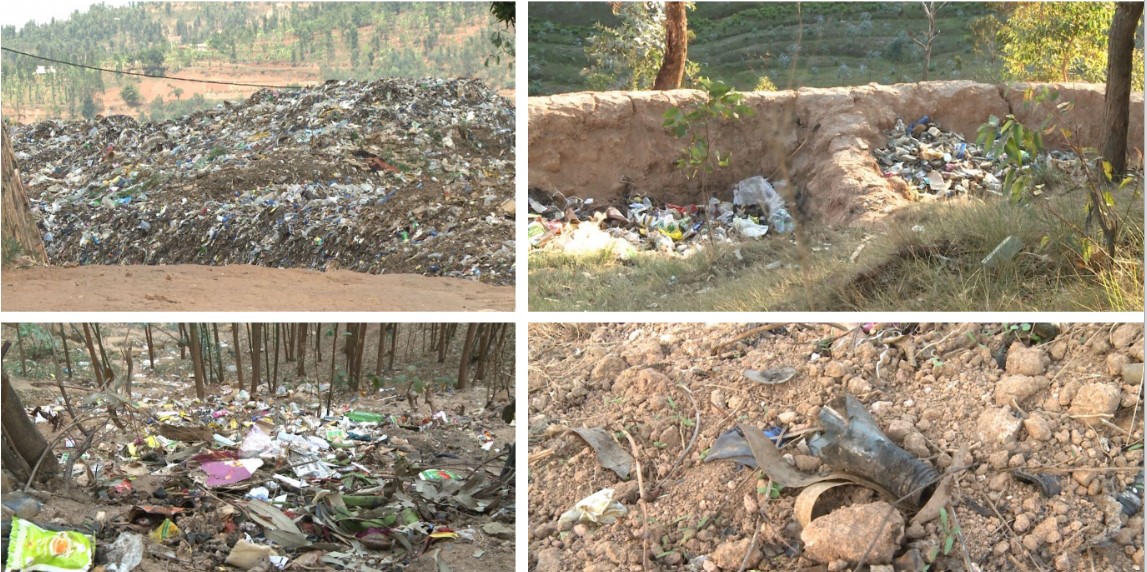
Waste management emerged as the most urgent environmental concern, with 41.11 per cent of respondents identifying it as an issue requiring the greatest government attention.
The report recommends that the Ministry of Environment, Rwanda Environment Management Authority (REMA), Ministry of Local Government and district authorities strengthen household waste management through designated collection points, improved access to licensed collectors, waste segregation, recycling, composting and adequate disposal facilities.
The findings show that illegal waste dumping was identified as a major challenge by 53.33 per cent of respondents. Another 41.11 per cent cited inadequate waste collection services, while 32.22 per cent pointed to insufficient collection points and facilities.
Poor waste management also has public health consequences. Some 76.67 per cent of respondents associated it with air pollution, 71.11 per cent with diseases and 64.44 per cent with bad smells. The report calls for stronger private-sector participation in waste collection, transportation and disposal.
Deforestation and illegal mining
Deforestation is another major concern. The assessment recommends community tree planting, household and community woodlots, improved cookstoves and affordable clean energy alternatives.
The findings show that 80 per cent of respondents associated deforestation with soil erosion. Landslides were reported by 53.33 per cent, while 51.11 per cent cited reduced water availability.
The report also recommends that farmers construct and maintain terraces, plant trees on hillsides, establish agroforestry plots and improve drainage systems to restore degraded land. Illegal mining requires stronger supervision and enforcement.
The assessment found that 20 per cent of respondents reported illegal mining in their areas. Its effects include soil erosion, cited by 18.89 per cent, loss of agricultural land and land degradation, each reported by 16.67 per cent.
It recommends regular inspections of mining sites, enforcement of regulations, closure of illegal operations and rehabilitation of abandoned mining pits.
Citizens must participate in environmental decisions
Hon. Abbas Mukama, Deputy Ombudsman in charge of preventing and fighting corruption, says environmental justice requires protecting citizens’ rights and involving communities in decisions affecting their lives.
“Communities should not merely be beneficiaries of development initiatives. They must be full participants in decisions that affect their environment, livelihoods, safety and well-being,” he says. He calls for stronger complaint-handling mechanisms, better coordination among institutions and timely feedback to citizens.
Colette Ndabarushimana, TI-Rwanda’s Policy and Legal Coordinator and Gender Focal Point, said the organisation’s Advocacy and Legal Advice Centre helps citizens understand their rights and obligations, receives complaints and refers cases to relevant institutions. She notes that the centre had received more than 65,000 complaints since its establishment in 2009.
Natalie Cass, Programme Officer for Governance, Human Rights and Reconciliation at the Embassy of Denmark in Rwanda, also underscored the importance of citizen engagement in improving governance and accountability, particularly in building climate resilience.
Climate resilience requires investment
The report identifies rainwater harvesting as the second-highest environmental priority, cited by 23.33 per cent of respondents.
Climate change-related financial support followed at 13.33 per cent, while deforestation accounted for 12.22 per cent. Illegal mining and land and property expropriation and compensation accounted for 6.67 per cent and 3.33 per cent, respectively.
The assessment recommends that districts strengthen disaster preparedness through flood-control drainage, hillside terracing, tree planting, early-warning systems and community disaster response plans.
It also calls for environmental awareness campaigns through Umuganda, school environmental clubs and community meetings.
Mupiganyi says TI-Rwanda works with relevant institutions to address citizens’ concerns and advocate for policy and legal reforms.
“Where we find gaps, we work with the relevant institutions. For example, when there are legal loopholes, we work with Parliament,” he says.
The assessment was conducted under the Citizen Action for Climate Resilience (CACR) Project, implemented across 10 districts. The social audits in the five selected districts were intended to generate evidence for advocacy and national policy dialogue.
The findings highlight the need to translate environmental policies into practical action, with stronger accountability, adequate resources and meaningful participation by communities.