By Rene Anthere Rwanyange
Millions face growing food shortages as poor rainfall, conflict, declining harvests and high food prices threaten regional food security through 2027.
Millions of people across East Africa face growing pressure to secure enough food as climate shocks, conflict, rising commodity prices and declining household stocks threaten food availability and access through May 2027.
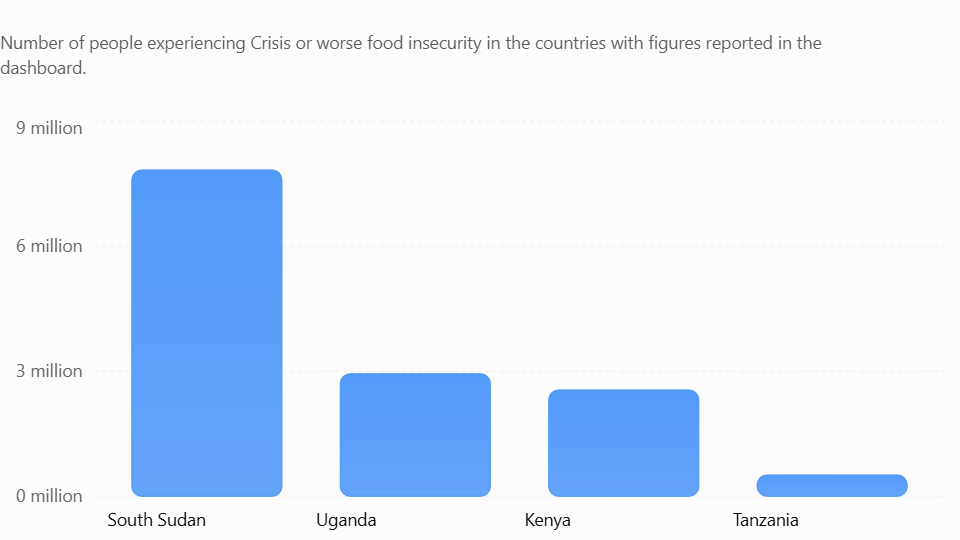
The region’s food security outlook remains fragile, with South Sudan, Uganda and Kenya recording millions of people experiencing severe food insecurity, while drought and poor rainfall threaten agricultural production in several countries.
This is according to the October 2026 edition of the Food Security Monitor, produced by AGRA under the Africa Food Trade and Resilience Initiative. The report examines food security trends in Ethiopia, Kenya, South Sudan, Rwanda, Tanzania and Uganda.
South Sudan remains the region’s most severe food crisis. About 7.83 million people are experiencing Crisis-level food insecurity or worse, representing 55% of the population analysed.
Uganda is facing a sharp deterioration. The number of people experiencing severe food insecurity reached approximately 2.94 million in October, equivalent to 16% of the analysed population. This represents a 337% increase compared with September.
Kenya recorded some improvement, with the number of people facing severe food insecurity declining by 17% to approximately 2.55 million. However, the outlook remains difficult. Between 3.5 million and four million people are expected to require food assistance between October 2026 and May 2027.
In Ethiopia, drought and conflict continue to undermine agricultural production and household access to food. Parts of Tigray, Amhara and Afar are projected to face Emergency conditions under the Integrated Food Security Phase Classification (IPC).
Uganda’s challenges are also expected to persist, particularly in Karamoja and refugee settlements. The report projects that food assistance needs could reach between three million and 3.49 million people in April and May 2027.
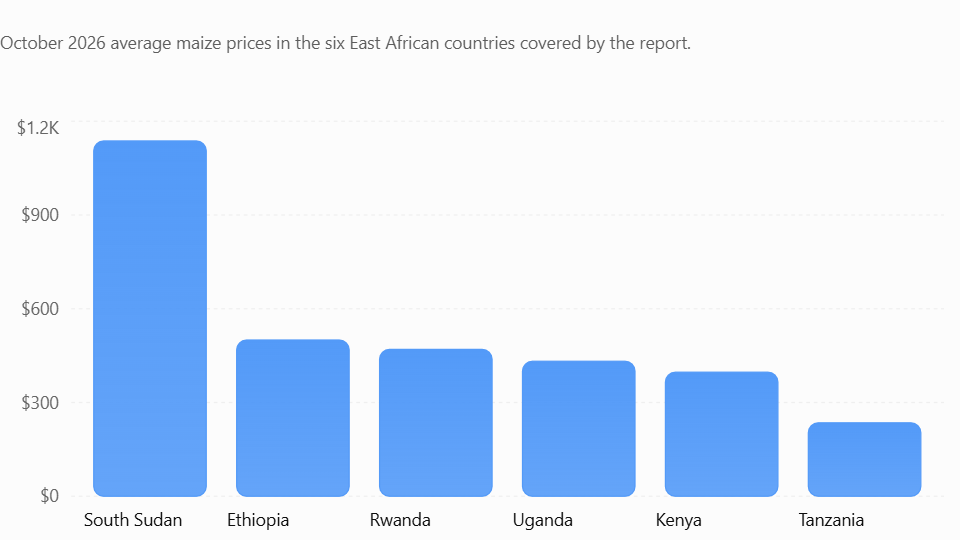
Rwanda and Tanzania face a different combination of pressures, including changing food prices and seasonal production risks. Maize prices increased in most of the monitored East African markets between September and October 2026, adding pressure on households that depend on the staple.
Rwanda recorded an 11% increase, with maize reaching US$470 per metric tonne. Prices rose by 8% in Uganda to US$432 and by 5% in Ethiopia to US$500. Kenya registered a 2% increase to US$397, while Tanzania recorded a 3% rise to US$235.
South Sudan was the exception. Maize prices declined by 5% to US$1,137 per tonne, but the country remained by far the most expensive market among the six monitored.
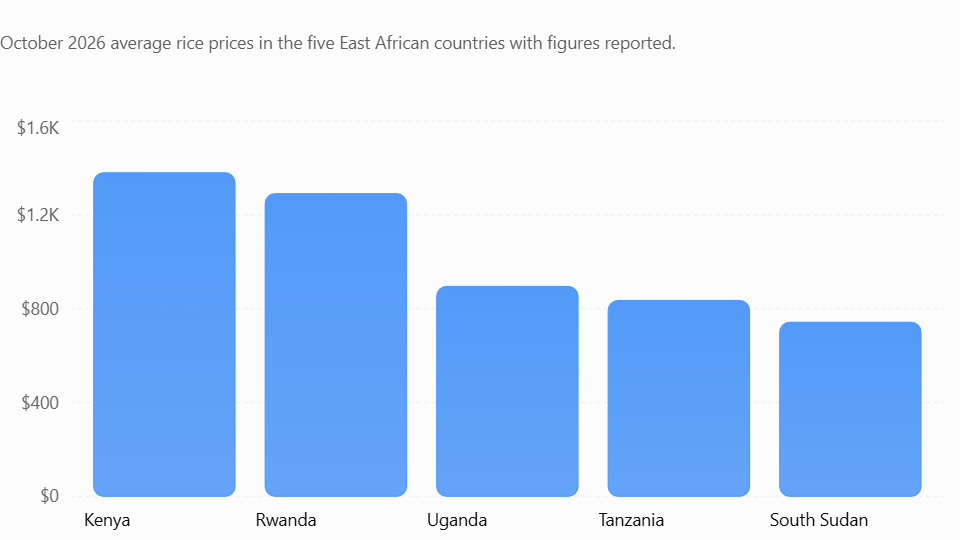
Rice prices moved differently. Rwanda recorded a 1% decline to US$1,291 per tonne, while Uganda registered a 7% decrease to US$895. South Sudan’s prices fell by 4% to US$742. Kenya and Tanzania recorded slight increases, reaching US$1,380 and US$835 per tonne respectively.
The figures underline the uneven nature of food markets across the region. A decline in the price of one commodity does not automatically mean that households can afford enough food. Purchasing power, market availability and transport costs also influence access. Beyond prices, the weather is emerging as another major threat to food production.
The report points to poor rainfall between June and September 2026 across northern and western parts of East Africa, affecting crop production and pasture availability.
In Ethiopia, drought and moisture shortages have constrained cereal production. In Kenya, poor rainfall affected main-season crops in major producing areas. Uganda also experienced rainfall deficits and high temperatures, particularly in northern and eastern areas.
There are some more favourable prospects. Improved rainfall forecasts could support the establishment of Season A crops in Rwanda, while planting of Season A maize is underway in Burundi. In Tanzania, farmers have started planting Vuli cereals in bimodal production areas, although dry conditions remain a concern in some locations.
The risks could become more pronounced from early 2027. Reduced harvests and declining household food stocks are expected to increase dependence on markets, placing additional pressure on families already struggling with high food costs. Conflict and displacement could further deepen food shortages, particularly in South Sudan.
The outlook places regional food trade and climate-resilient agriculture at the centre of efforts to strengthen food security. Better functioning markets and cross-border trade can help move supplies from surplus-producing areas to markets facing shortages.
For East Africa, the challenge extends beyond producing enough food. Countries must also strengthen supply chains and ensure that food reaches households at prices they can afford.
With food assistance needs expected to remain high into 2027, the report underscores the importance of timely action to protect agricultural production, support vulnerable households and strengthen regional food systems.