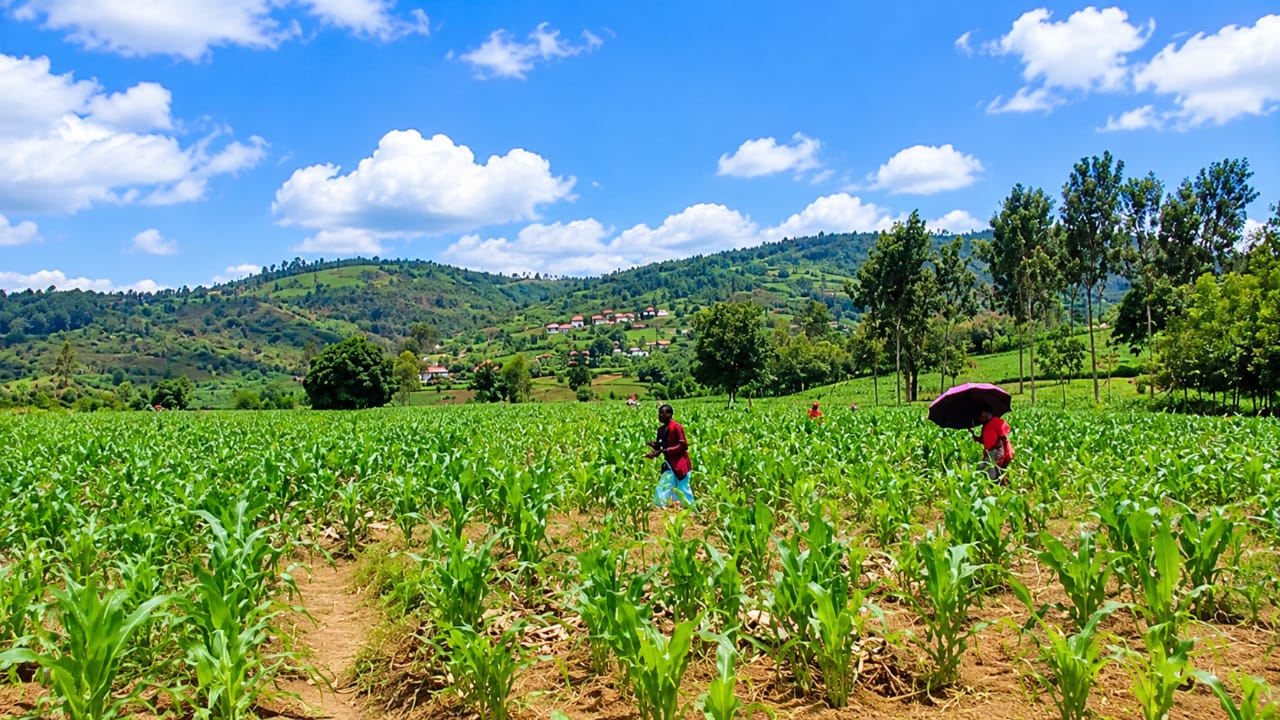
Farmers in Nyamasheke and Gisagara districts say that changing the way they farm has helped them increase crop production and reduce farming costs. They have adopted soil conservation practices, including mulching, applying manure and reducing soil disturbance.
These practices are part of conservation agriculture. They involve reducing the amount of ploughing, covering the soil with crop residues and applying fertiliser or manure where it is needed. Farmers using these methods say they help control soil erosion, retain moisture and improve crop yields.
Manirumva Celestin, the president of Macuba Cooperative in Nyamasheke District, says the methods have helped members spend less on farming while harvesting more.
“Mulched soil is not easily washed away by erosion. We farm on two hectares. Before, we spent RWF 400,000 to cultivate the land, but now we spend RWF 150,000. Before we started mulching, we harvested between five and six tonnes per hectare. Now we harvest more than eight tonnes,” he said.
Yankurije Doroteya, another member of Macuba Cooperative, says she has been farming for 15 years, but only began seeing significant results in the past three years after changing her farming practices and taking better care of the soil.
“We have been farming for 15 years, but it is only in the past three years that we have started getting good results. In the past, we ploughed the land and weeded in ways that disturbed the soil and damaged our crops. We did not know how to protect the soil and our crops. One farmer used to spend about RWF 80,000 on cultivation, but now spends no more than RWF 50,000,” she said.
Besides reducing farming expenses, these practices help the soil retain moisture and reduce the effects of heavy rain and intense sunshine. Mulching with crop residues also protects the soil from erosion. As the residues break down, they add nutrients to the soil.
In Macuba Sector, farmers say that caring for crops after planting is also important. They identify weeding, earthing up crops, mulching and checking for pests as activities that help protect their crops.
Yambabariye Sironi, a maize farmer from Kamina Village, Mutongo Cell, who farms with the Abadacogora group, says training on crop care changed the way the group manages its maize fields. Instead of throwing away the grass removed during weeding, they now use suitable plant residues as mulch.
“We used to plant our crops and leave them without further care. After receiving training, we started looking after them. For example, when maize grows, we weed around it without disturbing the soil or digging deeply. After weeding, we cover the soil around each plant with dry, decomposing grass. This has helped us get better harvests than before,” he said.
Farmers also say that regularly checking their fields helps them identify when crops need weeding or additional mulch. NYIRARUKUNDO Jeannette says they inspect their crops twice a week.
“We visit the crops we have planted twice a week. When we see weeds growing, we organise how to remove them. If the mulch has started to decompose, we move it closer to the crops so that it can act as manure, and then we add another layer of mulch. This helps our crops grow well,” she said.
Jean De Dieau UMWAMINIMUNGU, an employee of the Professional Farming Project run by African Evangelistic Enterprise (AEE), advises farmers not to use fresh grass that can grow again or negatively affect the soil. He recommends using dry plant residues that can decompose.
“When mulching crops, farmers should use dry materials such as rice husks left after harvesting rice, maize stalks and other dry residues. They should not use grasses such as urwiri and inteja, or other plants that can grow again. Such plants may compete with crops and may also increase soil acidity,” he said.
However, UMWAMINIMUNGU says the growing number of farmers adopting mulching has led to shortages and higher prices for materials used to cover the soil. He says the project is also teaching farmers to grow cover crops plants that spread across the ground — to provide mulch and protect the soil.
“These days, almost everyone is mulching their fields, which means farmers are finding it difficult to get the materials they need. We are also teaching them to grow cover crops. These plants spread across the ground and cover the soil, while the main crop grows above them. We hope this will help address the shortage,” he said.
Kayitare Joseph, another AEE staff member, says farmers should work together, especially when sourcing manure and materials for mulching. He explains that if some members of a cooperative do not follow the same practices, the benefits may be reduced.
“Farmers in cooperatives should work together in all their activities, including applying manure and mulching. If one farmer applies manure while another does not, the manure may spread and become less effective. In the same way, if one farmer covers the soil and another does not, erosion from the uncovered field can affect the others. Where possible, cooperative members should support one another financially and buy the materials they need so that they can apply manure and mulch their fields together,” he said.
The Professional Farming Project, run by African Evangelistic Enterprise (AEE) with support from Food for the Hungry, operates in selected sectors of Nyamasheke and Gisagara districts. It helps farmers learn and apply soil conservation practices.
In Nyamasheke District, the project supports 4,250 farmers organised in 200 groups and cooperatives in Kagano, Macuba and Kirimbi sectors. In Gisagara District, it supports 4,000 farmers organised in 200 groups in Muganza, Mugombwa and Kansi sectors.
Farmers say that continuing to care for the soil, working together and monitoring crops from planting to harvest can help them increase production and reduce losses.
Food for the Hungry operates in 20 countries. In 2025, it reached 10,222,078 people through different programmes aimed at improving their lives. In Rwanda, the organisation reached 299,806 people and worked with 67 families.