




























































































































Panorama economics
According to the report from the Alliance for a Green Revolution in Africa (AGRA), staple food and input markets across East Africa showed mixed price movements in October 2025. Maize prices generally declined month-on-month due to improved harvests, except in Rwanda (+10% to USD 440/MT).
South Sudan remained volatile despite a 19% drop to USD 923/MT, while Tanzania fell to USD 285/MT but remained 16.7% higher year-on-year. Rice prices were largely stable, with South Sudan easing to USD 695/MT (-5%) attributed to increased domestic and humanitarian supply. Tanzania recorded a slight decline to USD 917/MT (-2%), Rwanda rose marginally to USD 1,104/MT, and Kenya maintained the highest price at USD 1,288/MT due to continued import dependency.
Bean prices showed short-term stability with minor increases in Kenya and Uganda, while Tanzania recorded sharp declines, indicating strong supply. Wheat prices diverged across the region. Kenya posted a modest 2% month-on-month increase to USD 788/MT, largely driven by stock depletion, whereas Ethiopia recorded a moderate 4% decline to USD 545/MT.
The latter was primarily attributed to local currency depreciation against the US dollar, with the exchange rate widening to ETB 152.8 per USD, exerting downward pressure on dollar-denominated prices. Fertiliser prices surged across the region, most notably Rwanda (NPK +19.95% month-on-month) and Kenya (CAN +14.26%).
This reflected ongoing global supply chain disruptions, currency depreciation, and high import costs posing risks to production affordability and food security. These trends underscore persistent inflationary pressures and supply risks, highlighting the need for coordinated regional strategies to stabilise markets and safeguard food security.
Southern Africa’s staple food markets exhibited mixed trends, influenced by seasonal harvest outcomes, currency fluctuations, and input costs.
In Malawi, maize prices fell by 6.4% month-on-month to USD 729/MT (USD 279/MT at the parallel market rate), offering short-term relief likely linked to government interventions, including a state of catastrophe declaration and plans to import 200,000 MT of maize from Zambia.
Despite the decline, prices remain significantly higher than both three- and six-month averages, reflecting persistent foreign exchange constraints under a fixed exchange regime. In Zambia, maize prices increased by 9% to USD 276/MT, driven by local currency appreciation and increased demand from Malawi. In Mozambique, rice prices eased by 4.7% to USD 934/MT due to improved availability.
While favourable rainfall and government interventions have provided short-term relief in some areas, ongoing currency challenges and regional demand pressures continue to influence price dynamics. Ongoing monitoring will be essential to evaluate the impact of these developments on food security and market stability across the subregion. Fertiliser markets in Malawi and Mozambique showed contrasting trends with implications for agricultural planning.
Malawi recorded sharp monthly declines in NPK (−17.17%) and urea (−15.04%) prices, though medium-term increases persist. Year-on-year, NPK remains 31.11% higher, while urea is 41.1% lower but still up over the past six months.
Mozambique experienced modest changes, with NPK down 1.75% and urea up 1.01%, continuing a gradual upward trend. These trends highlight persistent affordability challenges for farmers, with Malawi showing short-term relief but medium-term strain, and Mozambique facing steady upward pressure.
In West Africa, staple food markets showed mixed short-term movements but an overall trend of price softening, driven by seasonal harvest inflows, policy interventions, and localised supply dynamics. Maize prices remained volatile: Ghana recorded a 6.7% increase to USD 407/MT supported by currency appreciation, while Nigeria and Togo experienced sharp declines (-5.3% and -8.3% respectively) due to import duty waivers and trader grain releases. Rice prices rose in coastal, import-dependent markets (Ghana, Nigeria, Togo) by 3–12%, reflecting currency pressures and long-term supply constraints.
In contrast inland markets (Niger, Mali, Burkina Faso) recorded marginal declines. Millet prices broadly fell across Burkina Faso, Mali, and Nigeria (9–12% month-on-month) due to increased harvest inflows and subsidized grain sales, while Niger remained largely stable except minor spikes in Zinder and Dosso. Sorghum showed contrasting trends: Ghana saw a sharp rise (14% to USD 522/MT), while Nigeria and Burkina Faso recorded significant drops (16.5% and 10.4% respectively), underscoring regional supply imbalances.
Food security
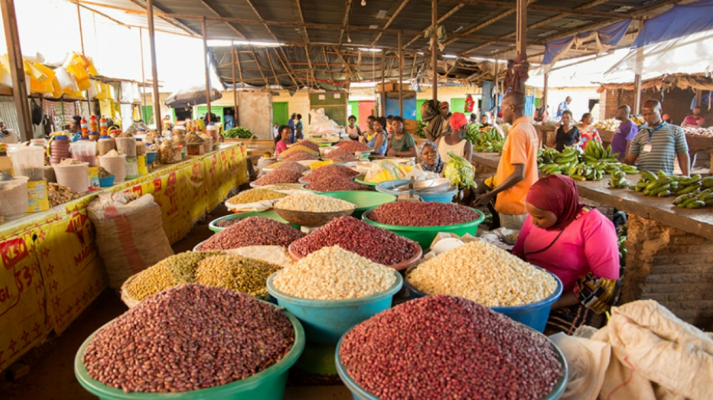
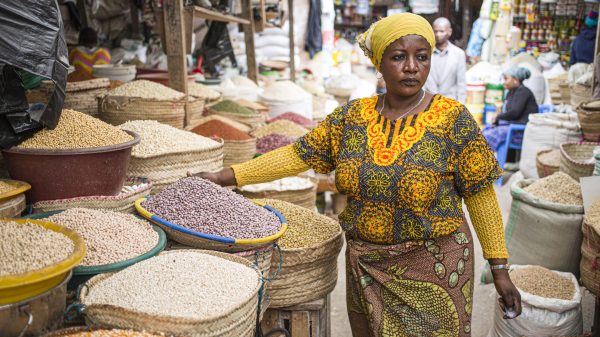
Food at the Rwandan market/ Photo: Courtesy
East and Central Africa continue to face widespread and severe food insecurity, with South Sudan and Ethiopia experiencing the most critical conditions, including areas at risk of famine. In South Sudan, over 5.9 million people are in Crisis (IPC Phase 3) or worse, a figure projected to rise to 7.5 million during the April–July 2026 lean season, driven by conflict, flooding, and economic collapse. In Ethiopia over 8 million people in Crisis with more than 1 million in Emergency, largely due to conflict, high food prices, and climate shocks.
Kenya’s ASAL regions remain highly vulnerable, with 2.1 million people expected in IPC Phase 3 or higher by early 2026. Uganda continues to experience food gaps in Karamoja and refugee-hosting districts despite seasonal improvements.
Tanzania shows moderate but improving conditions, while Rwanda remains relatively stable with localised stress. Across the region, acute malnutrition is widespread, compounded by disease outbreaks, poor WASH services, and constrained livelihoods, underscoring the urgent need for sustained humanitarian and resilience interventions.
Food insecurity across Southern Africa remains severe, with mixed recovery signals. In Malawi, widespread IPC Phase 3 (Crisis) outcomes persist in southern and central regions due to depleted stocks, high food prices, and reduced labour demand, continuing from 2024 when maize prices exceeded 160% above the five-year average. Mozambique’s food-insecure population is projected to rise to 2.67 million in 2025/26, up from 1.8 million during the 2023/24 El Niño drought, driven by erratic rainfall and insecurity in Cabo Delgado.
Zambia expects 1.7 million people to be in Crisis or worse, following the 2024 drought emergency that affected 6.6 million, which signifies a significant drop in the number of food-insecure people. Zimbabwe continues to face Crisis outcomes amid poor harvests and macroeconomic instability, following one of its driest seasons in decades. While some countries show signs of partial recovery, regional food security remains fragile, with millions still facing acute hunger.
West Africa faces severe and widespread food insecurity, with Burkina Faso, Mali, Niger, and Nigeria all experiencing Crisis (IPC Phase 3) or worse outcomes. Conflict-affected northern and eastern Burkina Faso and central Mali remain hotspots, with Mali also reporting Emergency (IPC Phase 4) conditions and alarming malnutrition rates. Niger continues to show extreme vulnerability, with over three-quarters of its population facing insufficient food consumption and conflict zones projected to remain in Crisis despite seasonal improvements.
Nigeria has the largest affected population, with over 30 million people in IPC Phase 3 or higher, and conditions expected to worsen during the 2026 lean season. Across the region, insecurity, displacement, high food prices, and limited humanitarian access are driving acute food insecurity, underscoring the urgent need for sustained assistance and resilience-building interventions.
Food trade
Ethiopia has officially started the shipment of goods under the African Continental Free Trade Area (AfCFTA) framework agreement. The first consignment, including meat, fruits, and various agricultural products, was dispatched to Somalia, Kenya, and South Africa.
The Government of Zimbabwe has lifted its ban on the importation of maize, grains, oilseeds, and related products, reversing restrictions imposed in August 2025. This instrument opens imports while introducing phased local sourcing requirements (40% by April 2026 and 100% by April 2028) to protect domestic farmers.
The Government of Malawi has secured a 200,000-tonne maize import deal with Zambia, although this is not enough to meet the projected maize deficit of 450,000 tonnes over the lean season. Tanzania has mandated its national food reserve agency to sell maize through an in-country office, hoping to provide a faster and formalised maize supply in Malawi.
Ghana and Niger have signed a new trade agreement to streamline their shared transit corridor by harmonising customs procedures, improving cargo tracking, and reducing extortion and excessive checkpoints that inflate trading costs between West Africa’s coast and its landlocked interior.