









































































By Martin Semukanya
For decades, Rwanda—and Rwandans—have carried a quiet but persistent critique: that of an oral society whose story was too often captured, interpreted, and framed by others. Outsiders wrote the books, named the events, and, by extension, shaped the way Rwanda’s past and future were imagined. On the evening of Friday, 27 February 2026, Kigali gently but decisively pushed back against that inheritance.
Across the city, three Rwandan authors, writing from different disciplines and life paths, presented their works to the public—on the same evening. It was not a festival curated months in advance, nor a state-orchestrated spectacle. It was something rarer and more organic: a convergence of Rwandan voices reclaiming narrative space. For lovers of culture around the world, and for Rwandan society itself, the simultaneity mattered as much as the books.
This was not only about literature. It was about who speaks, from where, and with what authority.
Starting Where Silence Was Longest: Assumpta Numukobwa
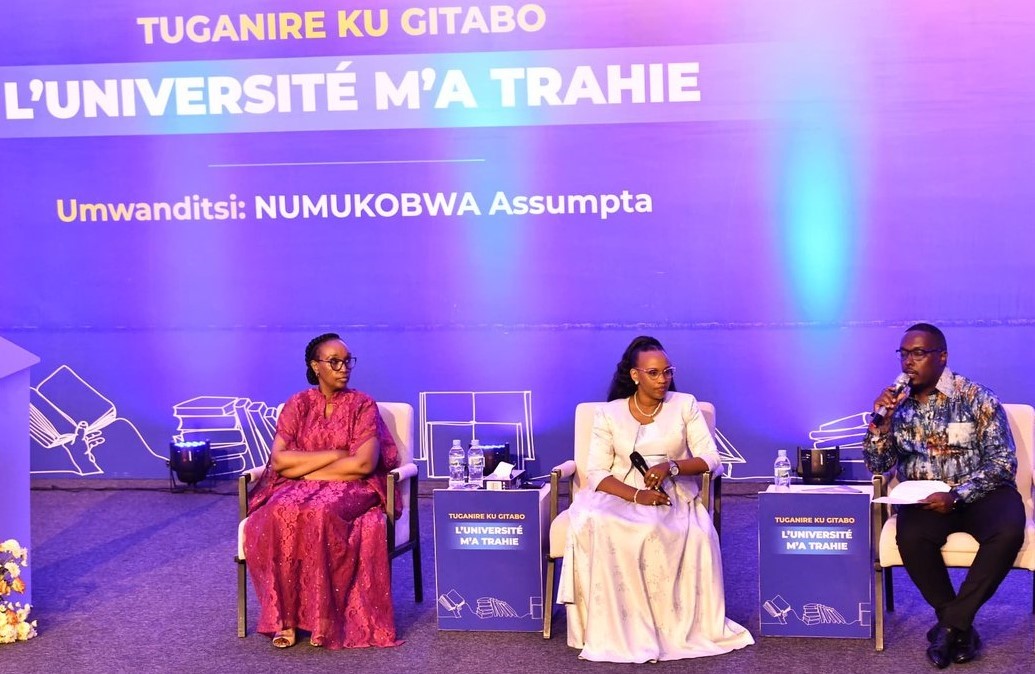
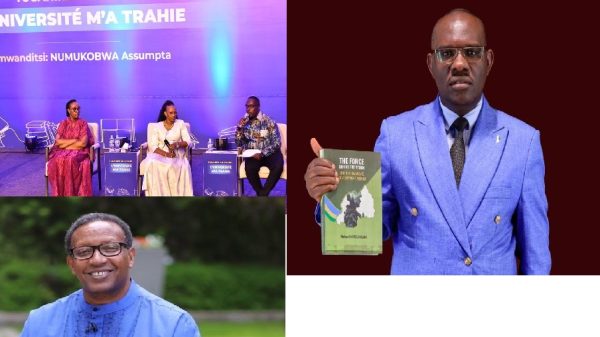
Author, Assumpta Numukobwa, flanked by Claver Irakoze Author/Moderator (right) and Francine Rutazana (left) Member of East Africa Legislative Assembly.
The least publicly known of the three authors opened the evening at the most symbolically charged venue: the amphitheater of the Kigali Genocide Memorial.
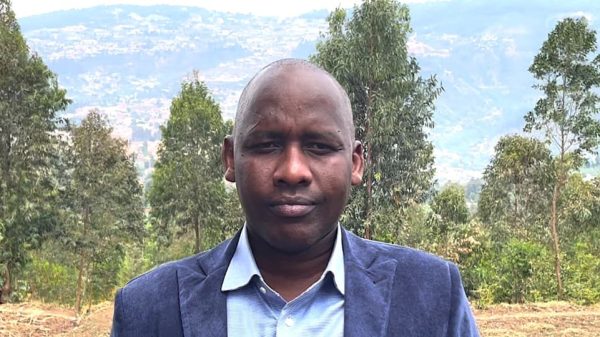
Assumpta Numukobwa introduced her first book, L’Université m’a trahie – Rescapée, fils de mon père. The title alone unsettles expectations. It does not promise comfort, academic distance, or polished retrospection. It announces betrayal—of an institution, of a promise, of a future once imagined.
Numukobwa speaks from a place long relegated to footnotes: the experience of students trapped by the Genocide against the Tutsi, far from their families, inside institutions that were meant to protect knowledge and life. As a young woman with high hopes—like so many of her generation—she entered university expecting intellectual emancipation, vibrant youth, and entry into adulthood. Instead, she witnessed how a genocide in the making, long visible yet unchallenged, finally swallowed even the spaces presumed neutral.
Her account confronts one of the most uncomfortable truths of 1994: that universities were not merely bystanders. She recounts being stranded on campus in Butare, separated from her family in Kigali, and ultimately from her elder brother—also a student—who did not survive. She describes the shock of watching lecturers, staff, and fellow students transform overnight into perpetrators, and the terror of realizing that yesterday’s ordinary classmates could, without warning, become killers—and proud of it.
The subtitle, Rescapée, fils de mon père (“Survivor, son of my father”), adds a layer of cultural and emotional depth. After the genocide, with no surviving sons, her father named Assumpta both daughter and son. In Rwandan tradition, the first son is heir, protector, and shield. In that naming, survival becomes responsibility; memory becomes duty.
Launching such a book at the Genocide Memorial was not incidental. It located her voice within national remembrance, but also insisted that survivor testimony is not only mourning—it is analysis, accusation, and authorship. For an author without decades of public visibility, this was a powerful declaration: silence is not humility; speech is not arrogance—it is repair.
Institutional Memory Written from Within: Richard Hategikimana
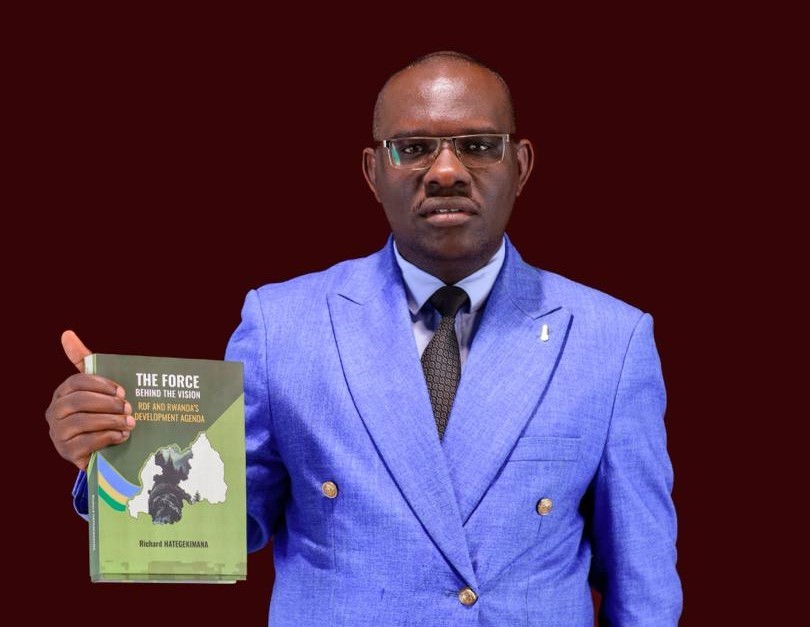
Across the city, at the Kigali Convention Centre, another kind of narrative was being offered—one that moves from survival to structure.
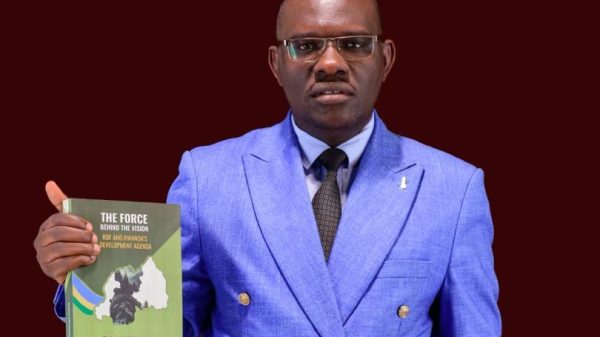
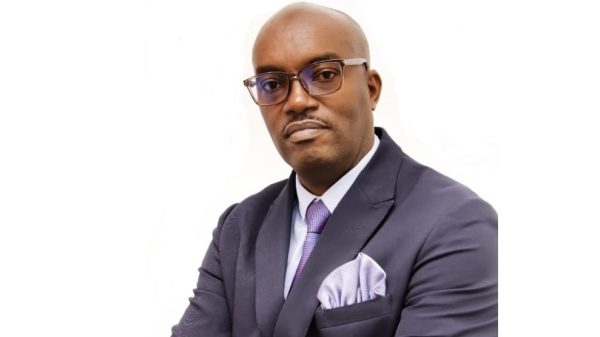
Richard Hategikimana, a well-established author and thinker, introduced The Force Behind the Vision – RDF and Rwanda’s Development Agenda. Hategikimana is not new to public discourse. He belongs to a generation of Rwandan writers who have worked steadily to document, interpret, and contextualize the country’s post-genocide transformation from the inside.
While the book itself addresses the role of the Rwanda Defence Force in national reconstruction and development, the broader significance of the event lies elsewhere: a Rwandan institution explained by a Rwandan author to a Rwandan audience. For years, analyses of Rwanda’s security model, governance, and development trajectory have largely circulated through foreign think tanks, academic journals, and policy briefs. Hategikimana’s work reclaims that interpretive space.
His presence at the Convention Center—often associated with global forums and international narratives—symbolically inverted the usual flow of explanation. This was not Rwanda being explained to the world. It was Rwanda explaining itself, on its own terms, in its own voice.
From Page to Stage: Jean Marie Vianney Rurangwa
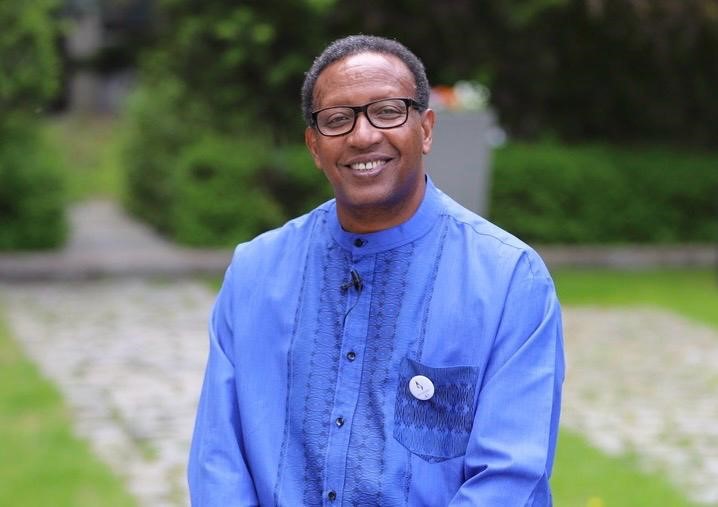
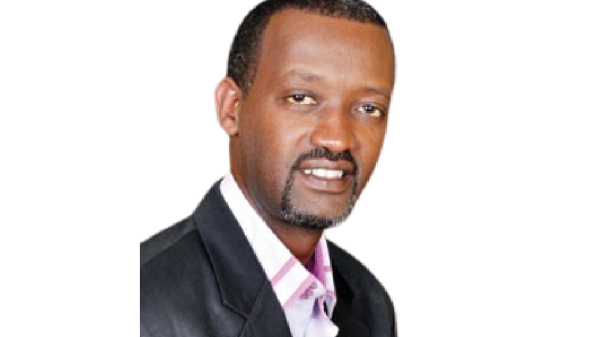
Popular author and playwright, Jean Marie Vianney Rurangwa
Meanwhile, at the Kigali Public Library, literature took a performative turn.
Jean Marie Vianney Rurangwa, a renowned author and playwright, presented his new stage work Mon Pays, Mon Phénix. Rurangwa is widely known for using theatre as a medium of national introspection—where memory, identity, and politics meet in embodied form.
That this work was introduced not in a theatre hall but in a public library is telling. It blurred boundaries between reading and performance, between solitary reflection and collective experience. Libraries, after all, are temples of recorded memory. By bringing a stage work into that space, Rurangwa affirmed that Rwanda’s story is not only to be archived—it is to be enacted, questioned, and felt.
The phoenix metaphor—rebirth from ashes—resonates deeply in a society where survival itself has become a shared language. Yet the choice of theatre underscores something else: oral tradition does not disappear when writing emerges. It evolves. Rwanda’s oral heritage finds continuity not in silence, but in dramaturgy, spoken word, and public performance anchored in written creation.
One City, One Evening, Three Voices: Why It Matters
What made the evening exceptional was not simply that three books were launched. It was that they happened simultaneously, in different corners of Kigali, addressing different dimensions of the Rwandan experience: survival, institutions, and cultural imagination.
This convergence challenges the old critique of an oral society that left others to write its story. Here, Rwandans were not only speaking—they were publishing, staging, and institutionalizing memory. They were doing so without intermediaries, without translation filters, and without seeking external validation.
For Kigali, this marks a quiet maturation. The city is no longer just a site where history happened, or where memory is curated for visitors. It is increasingly a city of authorship—where Rwandans generate their own archives of meaning.
For global culture admirers, the evening offered something rare: not Rwanda as subject, but Rwanda as author. Not Rwanda explained, but Rwanda writing back.
And for Rwandan society, perhaps the most important message was this: the future will not only be built through policies, memorials, or economic indicators—but through words owned, spoken, and preserved by those who lived the story.
Yesterday evening of February 28, 2026, Kigali did more than host book launches. It answered history.
X: @semukanyam